
Building Worlds Indoors: The Rise of Virtual Production

A New Chapter in Filmmaking
Rather than sending crews across continents or building elaborate physical sets, today’s filmmakers are increasingly turning to a different approach — creating entire worlds under studio lights. With rising costs, tighter production schedules, and growing demand for high-quality content from streaming and OTT platforms, Virtual Production offers a practical, creative alternative.
This shift isn’t just about saving money — it’s about reimagining what’s possible. Virtual Production (VP) lets filmmakers build immersive, flexible, and realistic cinematic environments in a studio.
What Is Virtual Production — And Why It Matters
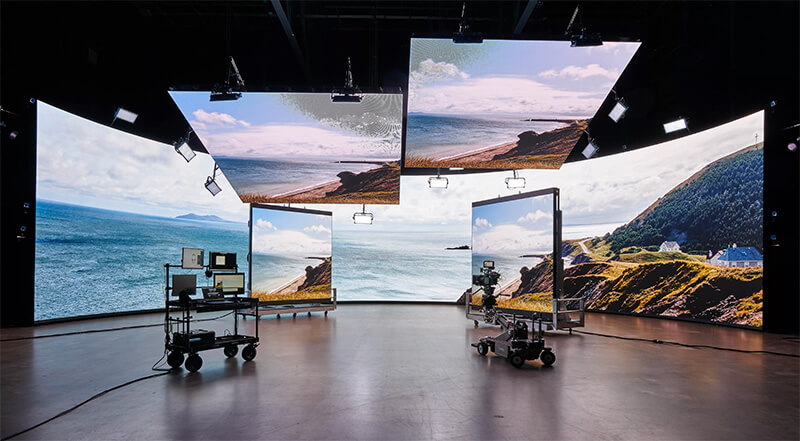
At its core, Virtual Production merges real-world filmmaking with real-time digital rendering. Live action performances, and practical props combine with computer-generated environments to create scenes that feel real — often captured “in-camera”.
Key components often include:
- LED walls or “volumes” — large, high-resolution displays that project virtual sets behind (and around) actors.
- Chroma Keying works identically but also offers flexibility as far as deliverables, and is an extremely cost-effective methodology.
- Real-time rendering engines (like Unreal Engine) that generate dynamic backgrounds on the fly.
- Camera-tracking systems (and sometimes motion capture), ensuring that as the camera moves, the virtual environment shifts appropriately — preserving accurate parallax, perspective, and reflections.
The result: filmmakers can “see” the final composite live with lighting, reflections, and backgrounds — as if shooting on a real location.

Benefits: Why Studios Are Embracing Virtual Production
Creative Freedom & Scale
With VP, you’re not limited by geography or practical constraints. You can build alien landscapes, fantasy worlds, futuristic cities — or recreate remote natural environments — all in a studio. This “world-building” capacity gives storytellers enormous creative flexibility.
Realism — In-Camera, Not Post-Production
Because scenes are composited in real-time, actors, props and scenery respond naturally to the environment. Reflections, shadows, and ambient light all behave believably. That makes the final footage completely photorealistic and reduces the need for extensive visual effects work later.
Speed & Efficiency
Traditional shoots — especially on location — come with major logistical challenges: travel, weather, unpredictable scheduling, and post-production heavy lifting. Virtual Production can often compress that. Changing scenery can be as simple as loading a new digital asset. Scenes that once required separate location shoots can now be done back-to-back in the same studio the same day.
Cost Savings (Long-Term)
Virtual Production reduces travel time, trucking, loading in and out, set construction, and heavy VFX workloads — savings that add up across multiple scenes, episodes, or projects. Plus, you end up owning the assets for late use or repurposing.
Flexibility & Control
Virtual Production gives filmmakers total control over the environment: time of day, weather, background details, lighting — everything programmable and adjustable. Continuity becomes easier, reshoots are less painful, and lighting/weather constraints nearly eliminated.

How It Works — From Pre-vis to Final Frame
- Pre-visualization & Design: Before filming begins, virtual environments are designed digitally. Set layout, lighting, camera paths — everything can be planned and tested virtually. This allows for early creative decisions without building physical sets.
- On-set Real-Time Shooting: During production, actors perform within virtual environments complete with the necessary practical props. The benefit of this is that actors can haptically relate to objects in a scene. Actors feel more comfortable, and the viewer can’t distinguish between what is practical and what is digital.
- In-camera Capture & Reduced Post-Production: Because much of what would have been added later via VFX is visible on set, the amount of compositing, lighting correction, and post-production needed are significantly reduced. The footage captured can be both ‘final pixel’, and elemental, enabling any and all traditional post work. This is ideal in cases where the CG is a W.I.P. placeholder and needs more tweaking later.

Real-World Impact: Where Virtual Production Is Already Changing the Game
Technical innovations and cost pressures have pushed Virtual Production from novelty to standard practice, across films, TV series, advertisements, and more.
Big-budget series and blockbusters benefit, but even smaller productions — commercials, indie projects, short films — are now able to leverage VP thanks to available tech and real-time rendering tools.
As workflows become more refined, and technology becomes more accessible, Virtual Production increasingly offers a faster, more efficient path from concept to realization — while offering unbounded creative opportunities at a fraction of the cost of traditional production methodologies.
What It Means for the Future of Filmmaking
Virtual Production represents a fundamental shift. It frees filmmaking from the constraints of physical location, weather, and time-of-day. It reduces costs and environmental impact. Most importantly — it grants filmmakers unprecedented creative flexibility.
As real-time rendering engines, LED volume technology, and camera-tracking systems evolve, the line between digital and physical filmmaking continues to blur. The “worlds” we once built by hand — painted backdrops, physical sets, location shoots — are giving way to programmable environments, controlled entirely from a computer.
Want to learn about Virtual Production and how to use it?
Cobalt’s got you covered. As the first company to offer Virtual Sets on the East Coast, we have the experience to guide you. Let’s have some fun.